Money
Greed
Laziness
Now, to break it down in dollars and cents, you have to understand the true cost of transferring files and how it’s done. There is no production in the internet, nor is there any raw materials (unless you consider electricity one). True, you may have to pay engineers to maintain things, but other than that you are left with things such as rent/lease/payments for buildings, equipment costs, and electricity.
 |
| How Bandwidth is made.......not really |
Equipment nowadays has gone way down in price recently, and is much more efficient. You can have many more units now with the same carbon footprint, and these units are much faster than before. So that still brings up the question why?
ISP’s (Internet Service Providers) and Cell phone companies
are the only ones that seem to get away with the underpants gnome methodology
of business. Most will say the caps only affect the top 5% of users, which I
would reply to with “yes, but what does that truly cost you, and if 95% don’t
go over the cap, wouldn’t the leftover bandwidth be more than enough to cover
the top 5%?” Of course, you’ll never get an answer to that, because it’s true,
and they got caught with their pants down.
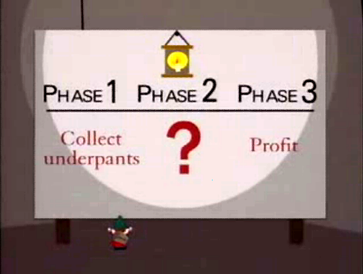 |
| Solid Business Plan |
What’s really upsetting is that a lot of big ISP’s like Comcast
do not disclose on average what a GB of transfer costs them. Amazon posts that their online web services
are between 2.5-5 cents/GB. If you factor that in to Comcast’s 250GB limit,
which includes upload and download, that’s $12.50 a month, if you use every
last bit of bandwidth. You can only assume that it is much less expensive for Comcast
per GB, as they own and operate their own network. In 2010, Comcast listed a $3.8 Billion profit,
which is after the NBC purchase*. This Increased by 42% in the last 2 years,
so I don’t think there are any dangers to their bottom line. Real purpose of
this is strategy. Whats funny, on the 10-K they list a revenue of 8.7 billion
in High-speed internet alone. Expense for running it ran at about $500 Million*,
so they make 16x more than what they put into it, sounds like a good investment
to me!
 |
| A Typical ISP Transaction |
Recently, Comcast has gotten in a lot of fights with Level3
and Netflix, for the sole reason of bandwidth use. Netflix allows streaming of
movies and TV shows, which makes Comcast jealous. Comcast has its own content
it wants you to use and pay for. Comcast angry…..very angry.
Now for me, I’m a bandwidth hog. I have Verizon FiOS, 1 of 2
high speed choices in my area. They do not have bandwidth caps, and never plan
to (At least yet). Verizon Currently has
around 9.1 million high speed customers (including DSL and FiOS)** and Comcast
rings in about 16 Million***. Verizon’s response to capping was “No Bandwidth Caps. Period!”**** Well
played, Verizon, Well played.

Other caps,
such as Cell Phone data caps, are definitely idiotic. Costs to operate these
towers have gone way down in the years, and with the inception of 4G, 2GB a
month seems paltry when in the scheme of things. 2GB is less than a DVD for an
entire month, and most data plans will run you around $30 a month PER LINE. Since
most speeds on cell phones now border DSL speed, and there really is no need to
download a ton yet on phones, usage on them is significantly less. I talked to
AT&T recently, and once they looked at my usage they said “WOW you use a
lot of data, 3.3 GB last month!” I replied, “I used 100 times that on my
internet connection at home, that’s nothing.” To put it in perspective, 3.3GB
is less than a Windows ISO, or a standard DVD. Somebody is making shit up.

No comments:
Post a Comment